Finding Your Size
Our size charts and measuring tips will help you order the correct size. If you don't have a measuring tape on hand, simply use a piece of ribbon or string and line it up against a yardstick. Feel free to contact us if you have any questions.
Select a Gap Fit Guide below:
Women's Tops, Outerwear & Dresses
Measuring Tips
Here are some tips to help you order the correct size. If you don't have a measuring tape, use a piece of string and hold it alongside a ruler.
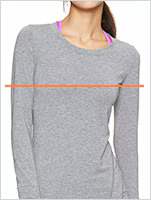
Bust
Lift your arms slightly and measure around your body (without a shirt is best), crossing over the fullest part of your chest.
Sleeves
With your arm bent at 90 degrees, place your hand on your hip. Measure from the back of your neck to your shoulder, elbow, and wrist.
Women's Jeans & Bottoms
Measuring Tips
Here are some tips to help you order the correct size. If you don't have a measuring tape, use a piece of string and hold it alongside a ruler.
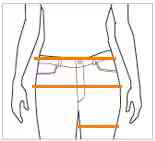
Waist
Measure around the natural waist, keeping the tape measure taut.
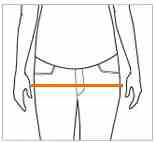
Hips
Stand with your heels together and measure around the fullest part of your hips.
Inseam
Measure straight down the inside leg from the crotch to the floor. For a shorter inseam, order an Ankle length size. For a shorter inseam and smaller overall fit, order a Petite size. For a longer inseam order a Long length size. For an extra-long inseam and proportionate fit, order a Tall size.
Women's Shoes & Accessories
Measuring Tips
Here are some tips to help you order the correct size. If you don't have a measuring tape, use a piece of string and hold it alongside a ruler.
Hats
Use a tape measure to measure the circumference of you head from ear to ear with a tape measure.
Gloves
Use a tape measure to measure the dominant hand above your thumb, around the back of your hand.
Belts
Measure around your waistline where you normally wear you pants. Keep a finger between your body and the measuring tape for an accurate fit.
Women's Bras & Panties
How to measure
If possible, get a friend to help.
How to Find Your Bra Size
here are two elements to your bra size: the band size
(i.e. 32, 34, 36, 38, 40) and the cup size (i.e. A, B, C,
D, DD). You will need a measuring tape to determine your
bra size.
You should take your measurements
while you are wearing a non-padded underwire bra or a
tight-fitting seamless tee.
Because standard
band sizes are even numbers only, you may need to go up or
down a size (depending on how you like your bra to fit) if
you have an odd-number band size.
Band Size
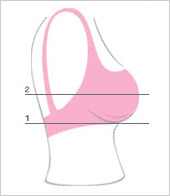
Wrap the measuring tape tightly around your rib cage (just below your bust), then add 5 inches to the measurement. For example: a ribcage measurement of 27” + 5”= 32” band size.
Double Check
You can double check your band size by measuring loosely around your back, even with your bra line, bringing the tape to the front just above your bra line.
Cup Size
Measure loosely around the fullest part of your bust, then
subtract your band size from this measurement. A
difference of 1”= A, 2”= B, 3”= C, 4”= D, 5”= DD. For
example: a cup measurement of 34” - 32” band size = 2” or
a B cup.
Now that you have your
measurements, knowing how the bra should be positioned on
your body will also help you find your perfect bra.
Find Your Right Fit
How your bra is positioned on your body is as important as taking accurate measurements. Here are a few key points to keep in mind when you're trying on bras to ensure that you get the right fit:
The Band
Should be fitted, but not cutting into your skin (you
should be able to fit two fingers comfortably under the
band). It should sit lower on the back than in the front.
The back of the bra should not ride up above the bra line.
If it does, adjust the straps. If the bra still rides up,
try a smaller band size.
The Underwire
Should completely surround the breast tissue to provide
support.
Sports Bras
.jpg)
Maternity Tops, Outerwear & Dresses
Measuring Tips
Here are some tips to help you order the correct size. If you don't have a measuring tape, use a piece of string and hold it alongside a ruler.
Things to Remember
Choose your maternity size based on your pre-pregnancy size. The maternity sizing allows room for a standard weight gain of 25-30 pounds.
Bust
Lift your arms up your sides and measure around your body, crossing over the fullest part of your chest.
Sleeves
With your arm bent and placed at your hip, measure from the back of your neck to your shoulder, elbow, and wrist.
.jpg)
Maternity Jeans & Bottoms
Measuring Tips
Determine your waist, hip, and thigh measurements with the help of our measuring tips. Then find your jean sizes in the charts below.
Things to Remember
Choose your maternity size based on your pre-pregnancy size. The maternity sizing allows room for a standard weight gain of 25-30 pounds.
Waist
Measure around the natural waist, keeping the tape measure taut.
Hips
Stand with your heels together and measure around the fullest part of your hips.
Inseam
Measure from crotch to floor- barefoot. Inseam is same length across all sizes. Choose between regular and exclusive inseams to find the right fit for you. Garment inseams are in product descriptions.
Petite Guide
Our petite sizes are based on height, not weight. If you're 5'4" and under, our petite collection was designed just for you. To learn more about petite sizes go to our Petite guide.
Tall Guide
Our tall sizes are based on height, not weight. If you're 5'9" and up, our tall collection was designed just for you. To learn more about tall sizes go to our Tall guide.
Maternity Bras
Choose your maternity size based on your pre-pregnancy size.
The maternity sizing allows room for a standard weight gain of 25-30 pounds.
Measuring Tips
Here are some tips to help you order the correct size. If you don't have a measuring tape, use a piece of string and hold it alongside a ruler.
How to Find Your Bra Size
There are two elements to your bra size: the band size
(i.e. 32, 34, 36, 38, 40) and the cup size (i.e. A, B, C,
D, DD). You will need a measuring tape to determine your
bra size.
You should take your measurements
while you are wearing a non-padded underwire bra or a
tight-fitting seamless T.
Because standard band
sizes are even numbers only, if you have an odd-numbered
band size, you may need to go up or down a size depending
on how you like your bra to fit.
Band Size
Wrap the measuring tape tightly around your rib cage (just below your bust), then add 5 inches to the measurement. For example: a ribcage measurement of 27” + 5”= 32” band size.
Double Check
You can double check your band size by measuring loosely around your back, even with your bra line, bringing the tape to the front just above your bra line.
Cup Size
Measure loosely around the fullest part of your bust, then
subtract your band size from this measurement. A
difference of 1”= A, 2”= B, 3”= C, 4”= D, 5”= DD. For
example: a cup measurement of 34” - 32” band size = 2” or
a B cup.
Now that you have your
measurements, knowing how the bra should be positioned on
your body will also help you find your perfect bra.
Find Your Right Fit
How your bra is positioned on your body is as important as
taking accurate measurements. Here are a few key points to
keep in mind when you're trying on bras to ensure that you
get the right fit:
Bra Straps
Should not cut into your shoulder blades. Adjust them
individually so they are comfortable and support breast
tissue. If your straps are falling down, you may not be
filling up the cups. Try a smaller cup size.
The Band
Should be fitted, but not cutting into your skin (you
should be able to fit two fingers comfortably under the
band). It should sit lower on the back than in the front.
The back of the bra should not ride up above the bra line.
If it does, adjust the straps. If the bra still rides up,
try a smaller band size.
The Underwire
Should completely surround the breast tissue to provide support.
Men's Tops & Outerwear
Measuring Tips
Here are some tips to help you order the correct size. If you don't have a measuring tape, use a piece of string and hold it alongside a ruler.
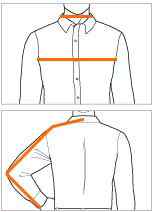
Chest
Lift your arms slightly and measure around your body (without a shirt is best), crossing over the fullest part of your chest.
Neck
For casual shirts, find a collared shirt that fits your neck well. Lay the collar flat on a table and measure the ”top” edge of the collar. For dress shirts, measure around the base of your own neck, keeping one finger between your neck and the tape measure.
Sleeve
Place your hand on your hip with your arm bent at 90 degrees. Measure from the middle of the back of your neck, across the shoulder, and down your arm to the wrist.
Tall Fit Guide
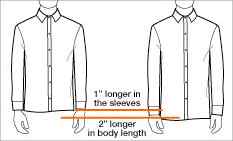
Tired of sleeves that are too short? Want shirts
that don't ride up whenever you raise your arms? You've
come to the right place. Our tall styles collection
features classic Gap styles, updated to fit you better
than ever. We've simply adjusted the proportions with our
tall-sized guys in mind. When buying tall styles, we
recommend ordering your regular Gap size.
Regular
Shirt vs. Tall Shirt
Our tall styles are for you if
regular-sized shirts fit in the chest and shoulders, but
the body length and sleeves are often too short.
Sizes
M- XL: 2” longer in the body
Sizes XXL- XXXL: 1 ½”
longer in the body
Long-sleeved styles: 1” longer in
the arm than regular sized styles
Short-sleeved
styles: ½” long in the arm than regular sized styles
Men's Bottoms
Measuring Tips
Here are some tips to help you order the correct size. If you don't have a measuring tape, use a piece of string and hold it alongside a ruler.
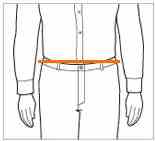
Waist
Measure around your waist where your pants usually fall. Keep one finger between the tape and your body to ensure an accurate fit.
Men's Shoes & Accessories
Measuring Tips
Here are some tips to help you order the correct size. If you don't have a measuring tape, use a piece of string and hold it alongside a ruler.
Waist
Measure around your waist where your pants usually fall. Keep one finger between the tape and your body to ensure an accurate fit.
Hats
Use a tape measure to measure the circumference of you head from ear to ear with a tape measure.
Gloves
Use a tape measure to measure the dominant hand above your thumb, around the back of your hand.
Men's Tall Tops & Outerwear
Measuring Tips
Here are some tips to help you order the correct size. If you don't have a measuring tape, use a piece of string and hold it alongside a ruler.
Bust
Lift your arms slightly and measure around your body (without a shirt is best), crossing over the fullest part of your chest.
Sleeves
With your arm bent at 90 degrees, place your hand on your hip. Measure from the back of your neck to your shoulder, elbow, and wrist.
Girls Tops & Outerwear
Measuring Tips
Here are some tips to help you order the correct size. If you don't have a measuring tape, use a piece of string and hold it alongside a ruler.
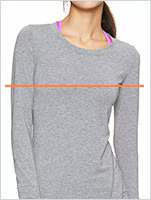
Chest
Lift your arms slightly and measure around your body, crossing over the fullest part of your chest.
Sleeve
Place your hand on your hip with your arm bent at 90 degrees. Measure from the middle of the back of your neck, across the shoulder, and down your arm to the wrist.
With growing kids one size does not fit all
Finding the right fit for the changing bodies of kids is not always easy. That's why our size range goes beyond the average. But how do you know if your kid needs a better fit?
Pants
Question:Are pants too tight or too long?
Answer:Plus
and husky pants are roomier at the waist, hip, thigh, and
leg opening. Thay are also shorter than regular.
Question:Are
pants too loose or baggy?
Answer:Slim pants offer a
narrower waist, hip, thigh, and leg opening. (Same length
as regular)
Tops
Question:In order for the shirt to fit through the chest
and back, are they too long in the sleeves?
Answer:Plus
and husky shirts offer fuller torsos and shorter sleeves.
Girls Bottoms
Measuring Tips
Here are some tips to help you order the correct size. If you don't have a measuring tape, use a piece of string and hold it alongside a ruler.
Waist
Measure around your waistline at the level where you normally wear your pants. Keep a finger between your body and the measuring tape for an accurate fit. For low-rise pants, measure a little bit lower than your natural waist.
Hips
Stand with your heels together and measure around the fullest part of your hips.
Adjustable Waist
The right size
Pull the elastic bands until the waist
is the perfect fit.
A firm hold
Fasten the
elastic bands to the buttons inside the waistband.
Always
adjustable
To loosen or tighten, simply adjust the
button placement.
With growing kids one size does not fit all
Finding the right fit for the changing bodies of kids is
not always easy. That's why our size range goes beyond the
average. But how do you know if your kid needs a better
fit?
Pants
Question:Are pants too tight or
too long?
Answer:Plus and husky pants are roomier at
the waist, hip, thigh, and leg opening. They are also
shorter than regular.
Question:Are pants too
loose or baggy?
Answer:Slim pants offer a narrower
waist, hip, thigh, and leg opening. (Same length as
regular)
Tops
Question:In order for the
shirt to fit through the chest and back, are they too long
in the sleeves?
Answer:Plus and husky shirts offer
fuller torsos and shorter sleeves.
Girls Accessories
Measuring Tips
Here are some tips to help you order the correct size. If you don't have a measuring tape, use a piece of string and hold it alongside a ruler.
Hats
Use a tape measure to measure the circumference of your head from ear to ear.
Gloves
Use a tape measure to measure the dominant hand above your
thumb, around the back of your hand.
Belts
Measure around your waistline where you normally wear you pants. Keep a finger between your body and the measuring tape for an accurate fit.
With growing kids one size does not fit all
Finding the right fit for the changing bodies of kids is
not always easy. That's why our size range goes beyond the
average. But how do you know if your kid needs a better
fit?
Pants
Question:Are pants too tight or
too long?
Answer:Plus and husky pants are roomier at
the waist, hip, thigh, and leg opening. Thay are also
shorter than regular.
Question:Are pants too
loose or baggy?
Answer:Slim pants offer a narrower
waist, hip, thigh, and leg opening. (Same length as
regular)
Tops
Question:In order for the
shirt to fit through the chest and back, are they too long
in the sleeves?
Answer:Plus and husky shirts offer
fuller torsos and shorter sleeves.
Boys Tops & Outerwear
Measuring Tips
Here are some tips to help you order the correct size. If you don't have a measuring tape, use a piece of string and hold it alongside a ruler.
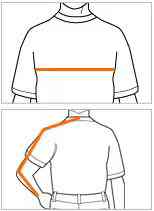
Chest
Lift your arms slightly and measure around your body, crossing over the fullest part of your chest.
Sleeve
Place your hand on your hip with your arm bent at 90 degrees. Measure from the middle of the back of your neck, across the shoulder, and down your arm to the wrist.
With growing kids one size does not fit all
Finding the right fit for the changing bodies of kids is
not always easy. That's why our size range goes beyond the
average. But how do you know if your kid needs a better
fit?
Pants
Question:Are pants too tight or
too long?
Answer:Plus and husky pants are roomier at
the waist, hip, thigh, and leg opening. They are also
shorter than regular.
Question:Are pants too
loose or baggy?
Answer:Slim pants offer a narrower
waist, hip, thigh, and leg opening. (Same length as
regular)
Tops
Question:In order for the
shirt to fit through the chest and back, are they too long
in the sleeves?
Answer:Plus and husky shirts offer
fuller torsos and shorter sleeves.
Boys Bottoms
Measuring Tips
Here are some tips to help you order the correct size. If you don't have a measuring tape, use a piece of string and hold it alongside a ruler.
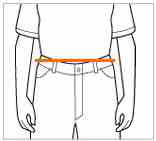
Waist
Measure around your waistline at the level where you normally wear your pants. Keep a finger between your body and the measuring tape for an accurate fit.
Adjustable Waist
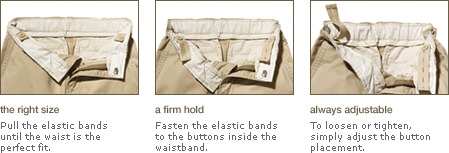
Available in all bottoms.
The right
size.
Pull the elastic bands until the waist is the
perfect fit.
A firm hold
Fasten the
elastic bands to the buttons inside the waistband.
Always
adjustable
To loosen or tighten, simply adjust the
button placement.
With growing kids one size does not fit all
Finding the right fit for the changing bodies of kids is
not always easy. That's why our size range goes beyond the
average. But how do you know if your kid needs a better
fit?
Pants
Question:Are pants too tight or
too long?
Answer:Plus and husky pants are roomier at
the waist, hip, thigh, and leg opening.
Question:Are
pants too loose or baggy?
Answer:Slim pants offer a
narrower waist, hip, thigh, and leg opening. (Same length
as regular)
Tops
Question:In order for the
shirt to fit through the chest and back, are they too long
in the sleeves?
Answer:Plus and husky shirts offer
fuller torsos.
Boys Shoes & Accessories
Measuring Tips
Here are some tips to help you order the correct size. If you don't have a measuring tape, use a piece of string and hold it alongside a ruler.
Hats
Use a tape measure to measure the circumference of your head from ear to ear.
Gloves
Use a tape measure to measure the dominant hand above your
thumb, around the back of your hand.
Belts
Measure around your waistline where you normally wear you pants. Keep a finger between your body and the measuring tape for an accurate fit.